STAT 20: Introduction to Probability and Statistics
Warmup
10:00
True or false?
One hundred draws will be made with replacement from the box: \(\boxed{\boxed{0}\quad \boxed{2} \quad \boxed{3}\quad \boxed{4} \quad\boxed{6}}\).
Which of the following statements are true? *
The expected value of the sum of the one hundred draws is 300, give or take 20 or so.
The expected value of the sum of the one hundred draws is 300.
The sum of the one hundred draws is 300, give or take 20 or so.
The sum of the one hundred draws is 300.
* From the text Statistics by Freedman, Pisani, and Purves
False (expected value is a constant)
True
True (value of random sum, on average, is 300, give or take one SD)
False
Concept Questions
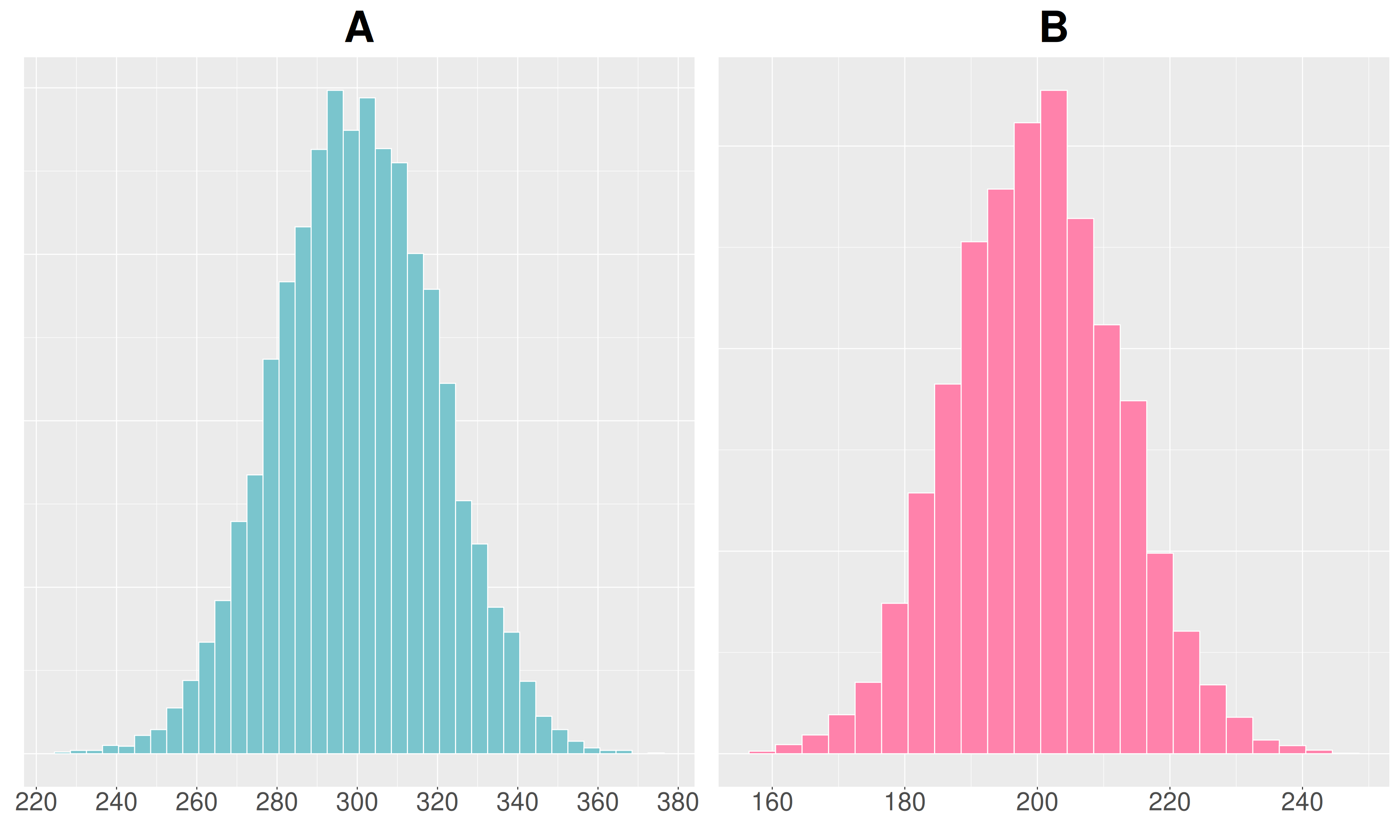
We have two random variables: \(X \sim\) Binomial(\(10, 0.2\)) and let \(Y\) be the value of one ticket drawn at random from a box with tickets \(\fbox{0}\, \fbox{2}\, \fbox{3} \,\fbox{4} \,\fbox{6}\).
We take the sum of 100 iid random variables for each of \(X\) and \(Y\), called \(SX_{100}\) and \(SY_{100}\). The empirical distributions of \(SX_{100}\) and \(SY_{100}\) are plotted below.
Which distribution belongs to which random variable?
01:00
01:00
A die will be rolled \(n\) times and the object is to guess the total number of spots in \(n\) rolls, and you choose \(n\) to be either 50 or 100. There is a one-dollar penalty for each spot that the guess is off. For instance, if you guess 200, and the total is 215, then you lose 15 dollars. Which do you prefer?*
Which do you prefer? \(n = 50\) rolls, or \(n = 100\) rolls?
* From the text Statistics by Freedman, Pisani, and Purves