Summarizing Categorical Data
The table below displays data from a survey on a class of students.
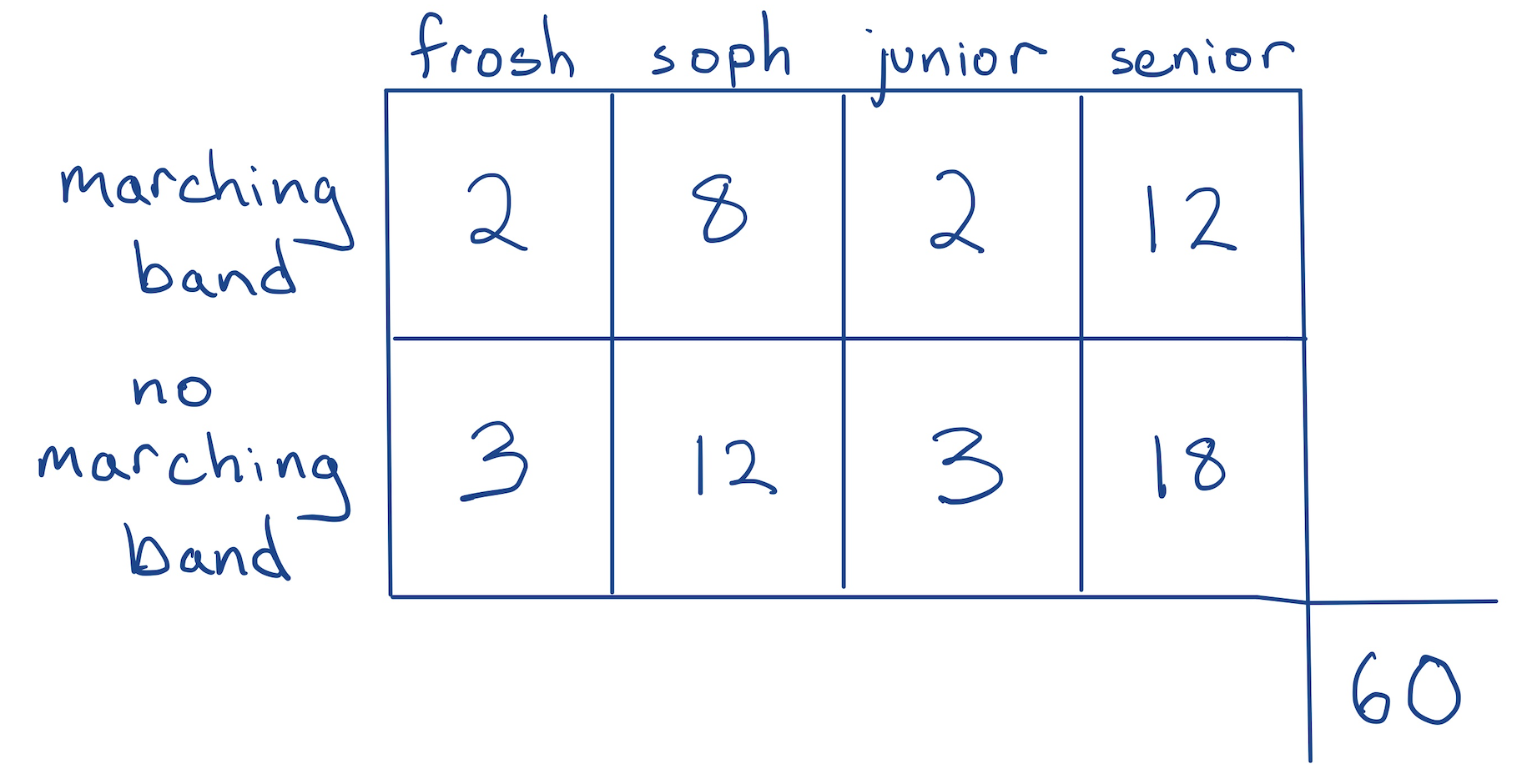
- What proportion of the class was in the marching band?
- What type of proportion is this?
- 24/60 (2/5)
- Marginal proportion
- What proportion of those in the marching band where juniors?
- What type of proportion is this?
- 2/24 (1/12)
- Conditional proportion
- What proportion were sophomores not in the marching band?
- What type of proportion is this?
- 12/60 (1/5)
- Joint proportion.
What were the dimensions of the raw data from which this table was constructed?
- 2 columns (marching band or not, year in school)
- 60 rows (we “observed” 60 students total)
How would you characterize the association between these two variables? (year in school, marching band status)
- They are unrelated (no association).
- Knowing one variable tells you nothing about the other.
- No matter what year in school we focus on, 2/5 of them are in marching band.
- Likewise, if we focus on only marching band students, 1/2 are seniors. If we focus on only non-marching-band students… still 1/2 are seniors.
Reading plots with proportions
The General Social Survey is a widely used source of data on the attitudes, behaviors, and attributes of Americans. This plot shows the relationship between the political affiliation and college degree status of 500 participants.
Which group is the largest?
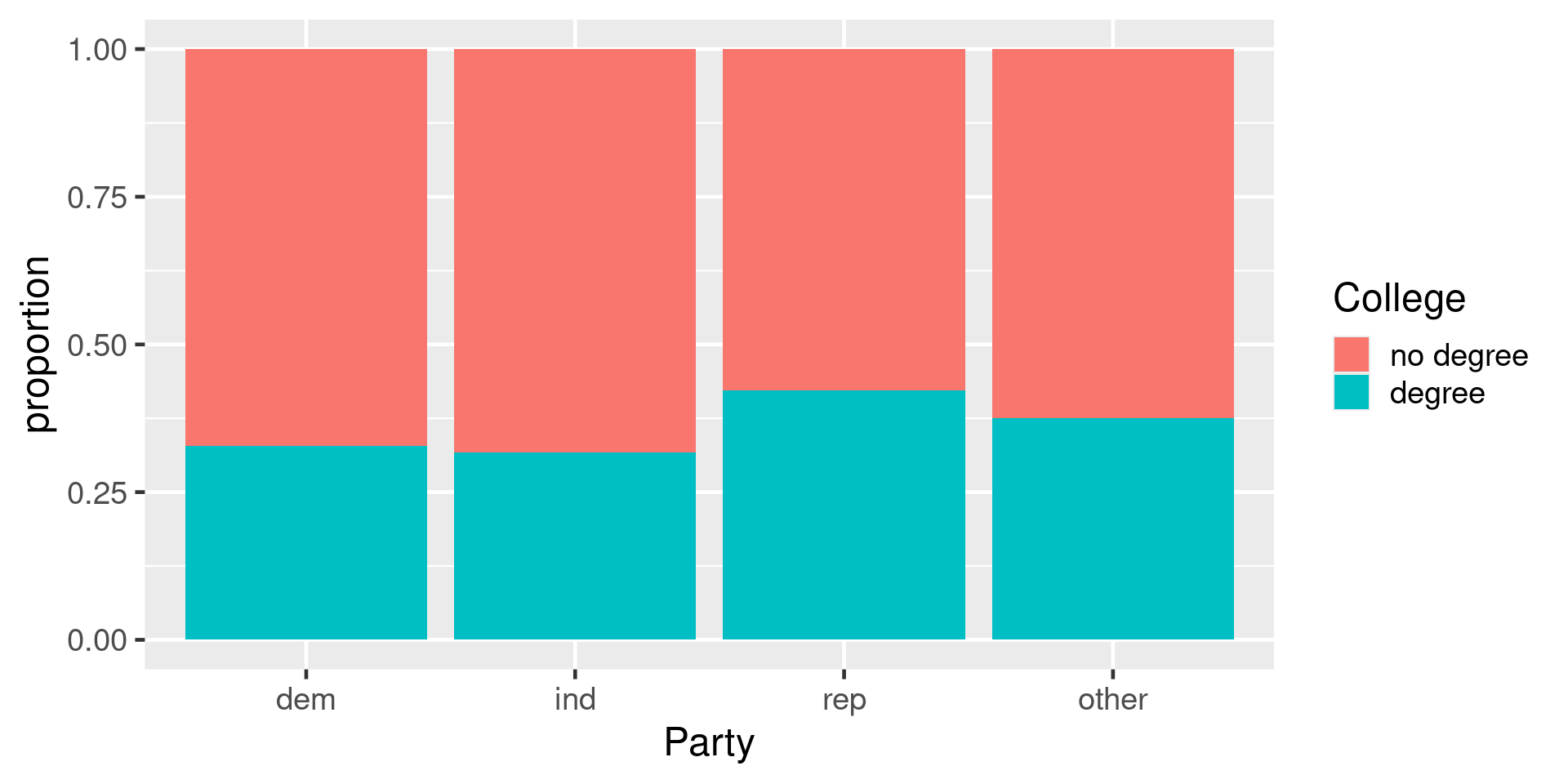
- You can’t tell!
- This plot as been normalized so that the proportions within each party sum to 1.
- Thus, you can’t tell how many individual people are in each group.
What does this plot show?
Discuss with your table for 2 minutes
02:00